
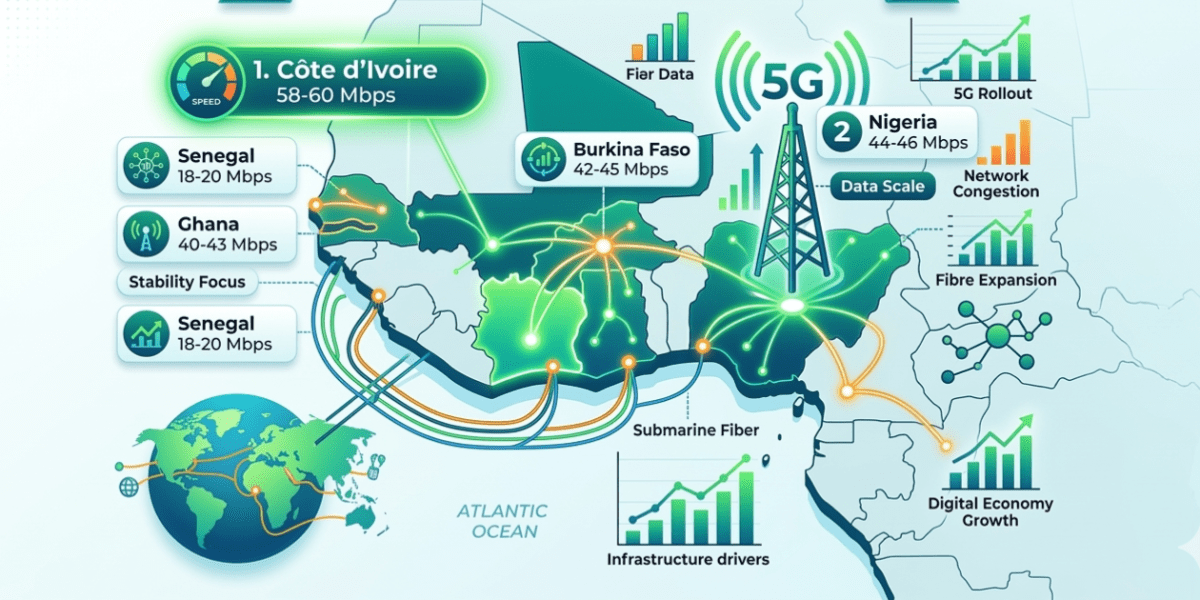
Across West Africa, internet performance in 2026 continues to vary widely. Differences in fibre infrastructure, aggressive 5G rollout, and geographical challenges shape how quickly users access the digital economy.
While many markets still grapple with congested mobile networks, others have leapfrogged traditional constraints through massive private-sector investment. According to recent Speedtest Global Index data and regional infrastructure reports, the gap between the leaders and the “mid-tier” is beginning to close, but infrastructure remains the ultimate differentiator.
2026 Regional Connectivity Overview
| Country | Avg. Download Speed (Mbps) | Primary Growth Driver |
| Côte d’Ivoire | 58–60 Mbps | Submarine Cable Integration |
| Burkina Faso | 42–45 Mbps | Targeted Urban Fibre Upgrades |
| Ghana | 40–43 Mbps | Competitive Mobile Market |
| Nigeria | 44–46 Mbps | Rapid 5G Expansion |
| Senegal | 18–20 Mbps | Network Stability & Fixed Broadband |
Why Côte d’Ivoire Leads West Africa’s Internet Rankings
Strategic Investment in High-Capacity Backbone
Côte d’Ivoire remains the regional benchmark for connectivity. With average download speeds consistently hitting the 58–60 Mbps range, the country’s performance is no accident. It is the result of deliberate investment in high-capacity fibre networks and the modernization of its digital backbone.
By strengthening integration with international submarine cable systems, Côte d’Ivoire has created a stable environment for demanding digital services. For businesses operating at scale, this infrastructure provides a level of reliability that is currently unmatched in the sub-region.
Burkina Faso and Ghana: The Rise of Efficient Networks
Impact of Targeted Infrastructure Deployment
One of the most notable trends in 2026 is the strong performance of Burkina Faso. Despite being landlocked, the country has achieved speeds exceeding 42 Mbps. This proves that market size and geography aren’t always barriers when infrastructure planning is prioritized.
Ghana continues to hold its ground as well. Benefiting from a highly competitive telecom sector, Ghana’s network improvements have been consistent, fueled by both consumer demand and a robust regulatory environment that encourages private investment.
Senegal’s Model: Reliability Over Raw Speed
Steady Growth in the Fixed Broadband Sector
Senegal offers a different perspective on digital growth. Rather than chasing the highest possible “peak” speeds, the focus has been on long-term stability.
National averages hover around 18–20 Mbps, with a heavy emphasis on strengthening the network in and around Dakar. While it may not top the raw speed charts, the reliability of Senegal’s connection has made it a favorite for remote work and technology-driven startups looking for a consistent ecosystem.
Nigeria 2026: A Large Market Navigating the “Scale Challenge”
The Impact of 5G and Urban Congestion
Nigeria presents the most complex picture in the region. Recent reports place Nigeria’s median download speeds at approximately 44–46 Mbps. While this is a massive leap from previous years, the country still sits in the middle tier due to its sheer scale.
The primary challenge in Nigeria isn’t a lack of technology, but the volume of traffic. With over 220 million people, the pressure on mobile and broadband infrastructure is immense. However, in major urban hubs like Lagos and Abuja, the reality is much different.
Key Insight: In 5G-enabled zones backed by MTN Nigeria and other major providers, mobile speeds frequently exceed 95 Mbps, demonstrating that Nigeria’s “pockets of excellence” are some of the fastest in Africa.
The ongoing challenge for Nigeria remains the urban-rural connectivity gap. While 5G has revolutionized the experience in cities, rural areas still rely on older, more congested 4G and 3G networks, which pulls the national average down.
Conclusion: The Future of West African Connectivity
The 2026 digital landscape shows that fibre expansion and 5G deployment are the two biggest predictors of economic success in West Africa. Countries like Côte d’Ivoire and Nigeria are proving that targeted investment can overcome geographical hurdles, though the “scale challenge” remains a factor for the region’s largest economies.
As we look toward the second half of the decade, the focus will likely shift from simply increasing speed to ensuring equitable access across all regions, not just urban centers.