iDeemlawful
  • News
  • Commentaries
  • Education
  • CourtRoom
  • Tech
  • Career
  • Lifestyle
  • World
iDeemlawful
  • News
  • Commentaries
  • Education
  • CourtRoom
  • Tech
  • Career
  • Lifestyle
  • World
iDeemlawful
iDeemlawful
  • About
  • Advertise
  • Editorial
  • Support

Copyright 2021 - All Right Reserved. Designed and Developed by PenciDesign

Tag:

Dangote refineries

Business

Petrol Surpass N1,000 per Litre as Tinubu Approves 15% Import Tariff

ideemlawful profile1iDeemlawful October 31, 2025
ideemlawful profile1iDeemlawful

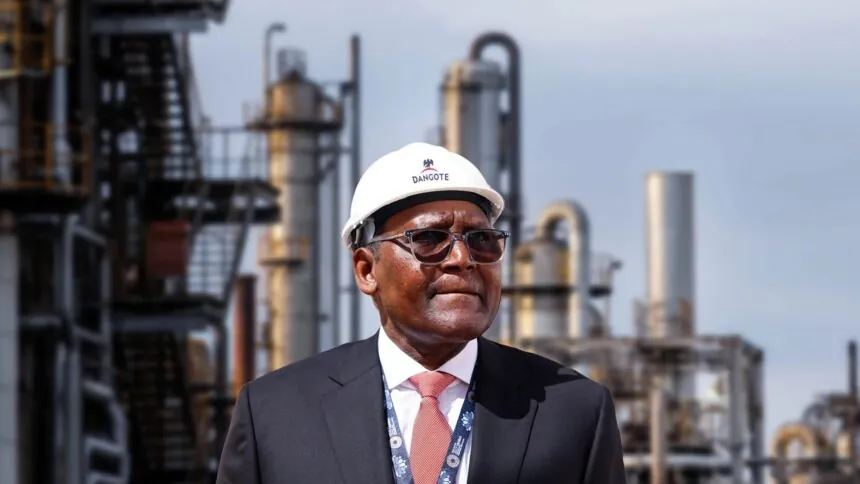
Petroleum marketers have cautioned that the pump price of Premium Motor Spirit, popularly known as petrol, could surpass N1,000 per litre following President Bola Tinubu’s endorsement of a 15 per cent ad valorem import tariff on fuel imports.

The new directive, set to take effect after a 30-day transition period ending on 21 November 2025, forms part of the government’s plan to safeguard local refiners and curb the influx of cheaper imported products that undermine domestic refining investments.

However, marketers warn that the decision might backfire, pushing retail prices beyond the reach of average Nigerians.

In separate telephone interviews on Thursday, several depot operators with direct knowledge of the issue—who requested anonymity—stated that the policy could further escalate petrol prices, which already hover around N920 per litre in many parts of the country.

“As it is, the price of fuel may go above N1,000 per litre. I don’t know why the government will be adding more to people’s suffering,” one depot operator said.

Another operator added, “Unfortunately, some of the importers are working in alignment with Dangote, which is why the last price increase was general; all players raised their prices at once. Let’s just wait and see what happens next.”

A third depot operator warned that without a defined framework to stabilise market forces and ensure fair competition, the new duty could spark another round of price hikes and worsen consumer hardship.

The National Vice-President of the Independent Petroleum Marketers Association of Nigeria, Hammed Fashola, also acknowledged that the tariff would likely cause a price surge.

Fashola said the policy carries both positive and negative outcomes, noting it could discourage importation while boosting local refining efforts.

He expressed concern that some marketers might view the policy as an opportunity to monopolise the sector in favour of Dangote and a few other refiners.

“The 15 per cent tariff on imported fuel has its own implications. Maybe the price will go up, and equally, it will discourage importers from bringing in fuel if it becomes too costly.

“But it has both negative and positive effects on the sector. I see that the government is trying to protect local refiners, but it will have its own implications because people will see it as a way of monopolising the industry for certain people. At the same time, the government aims to protect the local refiners.”

Fashola further cautioned that if local refiners failed to produce sufficient fuel for the domestic market, it could trigger another scarcity.

“If the local refiners fail, it will have its own implications. It may lead to scarcity, and people will not have an alternative. So, it has both positive and negative effects. That’s the way I see it,” he added.

On whether the development aligns with the Petroleum Industry Act, Fashola said, “I don’t think the government will do anything outside the law. They would not like to do anything against the PIA. Ordinarily, everybody would like to see that our local refineries are surviving and they are doing well, which is good for our economy. I don’t think it has anything to do with the PIA.”

Advising local refiners, particularly the Nigerian National Petroleum Company Limited, Fashola urged them to meet expectations and expedite the revival of the Port Harcourt, Warri, and Kaduna refineries.

“My advice or my prayer is to the new management of NNPC: the way they are going, I think they are going in the right direction, and they have to do it fast by bringing in investors to revive our refineries. If all NNPC refineries can come on board, it will solve a lot of problems. I hear people trying to say that maybe they’re going to practise monopoly, but that will not be there. This applies to other private refineries like BUA; when they are able to come up, I think that the fear of monopoly will not be there anymore. There will be competition among the refineries, and that will be good for us,” Fashola stated.

Meanwhile, the National President of the Petroleum Products Retail Outlet Owners Association of Nigeria, Billy Gillis-Harry, described the 15 per cent tariff as a balanced policy, noting it would still need to be tested over time.

“Our expectation is that at some point, it might be reviewed. We are looking for product availability and affordability. We must always keep an eagle eye on these two things. That’s what PETROAN will advise at this time. I want Nigerians to know that if we are looking for cheap fuel and we are driving everybody out of the business, the product will not be available, and then prices will skyrocket.

“As it is today, everybody is working with Dangote, and we know that Dangote cannot satisfy the country. So, there has to be a mix of product availability,” he added.

President Tinubu approved the introduction of a 15 per cent ad valorem import duty on petrol and diesel imports into Nigeria.

The initiative is intended to protect domestic refineries and stabilise the downstream oil market. In a letter dated 21 October 2025, made public on 30 October 2025, and addressed to the Attorney-General of the Federation and Minister of Justice, the Federal Inland Revenue Service, and the Nigerian Midstream and Downstream Petroleum Regulatory Authority, Tinubu ordered the immediate implementation of the tariff as part of a “market-responsive import tariff framework.”

The letter, signed by his Private Secretary, Damilotun Aderemi, followed a proposal by the Executive Chairman of the FIRS, Zacch Adedeji.

The proposal recommended a 15 per cent duty on the cost, insurance, and freight value of imported petrol and diesel to align import costs with domestic market conditions. The tariff is distinct from the additional 5 per cent surcharge applicable to locally produced and imported fuel under the new tax act starting January 2026.

Adedeji, in his memo, explained that the measure is part of broader reforms aimed at boosting local refining, ensuring price stability, and supporting the naira-based oil economy under the Renewed Hope Agenda for energy security and fiscal sustainability.

According to projections in the letter, the 15 per cent duty could raise the landing cost of petrol by approximately N99.72 per litre, based on average daily consumption of 19.26 million litres as of September 2025. This could generate an additional N1.92bn in daily import costs and government revenue.

The letter read, “At current CIF levels, this represents an increment of approximately N99.72 per litre, which nudges imported landed costs towards local cost recovery without choking supply or inflating consumer prices beyond sustainable thresholds. Even with this adjustment, estimated Lagos pump prices would remain in the range of N964.72 per litre ($0.62), still significantly below regional averages such as Senegal ($1.76 per litre), Côte d’Ivoire ($1.52 per litre), and Ghana ($1.37 per litre).”

It further stated that payments would be made into a designated Federal Government revenue account managed by the Nigeria Revenue Service, with verification and clearance oversight by the NMDPRA.

“The core objective of this initiative is to operationalise crude transactions in local currency, strengthen local refining capacity, and ensure a stable, affordable supply of petroleum products across Nigeria,” Adedeji stated.
October 31, 2025 0 comments
0 FacebookTwitterPinterestEmail
BusinessFeatured

Relief for Nigerians as Dangote Slashes Cooking Gas Price to ₦760/kg

ideemlawful profile1iDeemlawful October 7, 2025
ideemlawful profile1iDeemlawful

Dangote Refinery has slashed its ex-depot price for Liquefied Petroleum Gas (LPG), widely known as cooking gas, from ₦810 to ₦760 per kilogram, providing long-awaited relief to Nigerian consumers.

According to reports, market comparisons reveal that Matrix and Ardova depots currently sell LPG at ₦920 per kilogram, while A.Y.M Shafa and NIPCO charge ₦910 per kilogram. Stockgap Depot maintains a higher rate at ₦950 per kilogram.

The pricing difference — with Dangote’s ₦760/kg compared to others between ₦910 and ₦950/kg — reflects a ₦150 to ₦190 gap, signalling the refinery’s deliberate move to reshape the domestic market and compel rival depots to cut prices.

Industry analysts believe Dangote’s decision is a calculated step to restore market balance and curb excessive price hikes that have long destabilised the LPG sector.

“Dangote’s post-maintenance price cut shows intent, not only to restore volumes but to realign pricing discipline in the domestic LPG market,” an industry analyst stated.

This adjustment comes amid a steep rise in cooking gas prices, which recently soared from ₦1,000 to as high as ₦3,000 per kilogram in Lagos and other cities across the country.

The surge has left many Nigerians frustrated, as long queues formed at the few gas plants that still had supplies available.

However, the Group Chief Executive Officer of the Nigerian National Petroleum Company Limited (NNPCL), Bayo Ojulari, attributed the sharp rise in LPG prices to the recent strike by the Petroleum and Natural Gas Senior Staff Association of Nigeria (PENGASSAN).

Speaking to State House correspondents after meeting President Bola Tinubu on Sunday, Ojulari explained that the industrial action halted loading and distribution for several days, triggering an artificial spike in prices.

He assured Nigerians that prices would soon stabilise as operations across the supply chain return to normal.

October 7, 2025 0 comments
0 FacebookTwitterPinterestEmail
Business

Dangote Offers Sacked Workers 5-years Salary Without Work

ideemlawful profile1iDeemlawful October 3, 2025
ideemlawful profile1iDeemlawful

The Dangote Refinery has reportedly offered to keep paying the salaries of dismissed workers for five years without requiring them to work, citing fears of sabotage if they remained at the facility.

According to PREMIUM TIMES, the proposal was made during a negotiation involving the Petroleum and Natural Gas Senior Staff Association of Nigeria (PENGASSAN) and the Federal Government.

While government officials expressed concerns about the financial burden of such an arrangement, Dangote management maintained it was safer and ultimately cheaper than keeping workers it no longer trusted within the refinery.

However, PENGASSAN flatly rejected the offer, insisting instead that the affected staff be redeployed across other subsidiaries of the Dangote Group.

A source familiar with the talks told PREMIUM TIMES: “Dangote offered to pay the sacked workers for five years to stay at home or do other things, but they will be paid monthly.

“They will not be allowed near the refinery because of fears of sabotage. Even though government representatives said the offer may be too much of a burden, Dangote insisted it was a lesser risk. But PENGASSAN rejected it.”

Explaining the union’s stance, PENGASSAN general secretary, Lumumba Okugbawa, said the adopted resolution was centred on workers’ welfare, noting that multiple options were considered before a compromise was reached.

“So, the option that he wants to pay salary for five years without any work. I don’t think the option is important at the final stage. The most important thing is that what did you agree? That’s what you will do and not, what they disagree on,” he said.

Although some sources suggested redeployment could lead to resignations if workers were posted to far-flung locations, Okugbawa dismissed the concerns as mere speculation, stressing that employees are expected to resume duties wherever assigned.

He likened the union’s role to mediating between a husband and wife, saying the ultimate goal was reconciliation and cooperation between both sides.

“All we are interested in is our workers’ welfare. Dangote refinery is losing no kobo and people should not think that we are interested in his business model. The most important thing is that these people have their jobs back,” Okugbawa added.

Background

The Dangote Petroleum Refinery recently terminated the employment of several workers over alleged sabotage, citing operational and safety risks.

The move triggered protests from PENGASSAN, which accused the refinery of anti-labour practices and directed members nationwide to withdraw services.

Following government intervention, a court order, and days of negotiations, both sides reached a deal recognising workers’ right to unionise.

Disengaged staff will now be redeployed within the Dangote Group without loss of pay.

Announcing the suspension of the strike, PENGASSAN president Festus Osifo warned the union would resume action without notice if the agreement was violated.

October 3, 2025 0 comments
0 FacebookTwitterPinterestEmail
Business

JUST IN PENGASSAN Threatens Dangote Refinery After Strike Suspension

ideemlawful profile1iDeemlawful October 2, 2025
ideemlawful profile1iDeemlawful

The Petroleum and Natural Gas Senior Staff Association of Nigeria (PENGASSAN) has issued a fresh warning to Dangote Petroleum Refinery after suspending its strike.

On Wednesday, PENGASSAN President, Festus Osifo, announced the suspension in Abuja, explaining that the decision followed meetings with the National Security Adviser and Dangote management.

Earlier, the Minister of Labour and Employment, Mohammed Dingyadi, confirmed that both parties had reached a compromise, stating that more than 800 disengaged workers would be reassigned to Dangote Group subsidiaries without loss of pay.

“Unionisation is a legal right of workers,” the minister said. “No worker will be victimised for participating in the dispute.”

However, speaking on Channels Television’s The Morning Brief on Thursday, Osifo clarified that PENGASSAN never signed the communiqué presented as the settlement of the strike.

“If you see that communiqué, we did not sign it. Normally, it is supposed to be signed by three parties. We did not sign because we felt that some things in it were not okay with us,” he said.

He stressed that the statement was merely a communication from the Minister of Labour and Employment, not an agreement.

“When we subjected it to our NEC, we had to decide on priorities. Some media houses claimed we were only interested in check-up dues. That is false. What we prioritised was how our members would return to work and provide for their families.”

According to him, PENGASSAN’s position remains firm: “Take the people back to the refinery.” He added that Dangote initially refused to reabsorb the sacked workers until the government intervened to push for a compromise.

Osifo dismissed Dangote’s allegations that the disengaged workers were sabotaging the economy.
“The release that Dangote made on workers sabotaging the economy was totally incorrect. If we had allowed that sabotage tag to stand, those 800 people would not be able to secure jobs in the future. That stigma would remain forever,” he said, calling its removal “a very big win.”

The PENGASSAN boss maintained that the union’s struggle was about protecting Nigerian workers.
“If Dangote does not do the needful, our tools are always available. We will never get tired of struggling for what is right. We have been around for 50 years before the Dangote Refinery came on stream,” he declared.

October 2, 2025 0 comments
0 FacebookTwitterPinterestEmail
Business

PENGASSAN to End Strike After Dangote, Labour Accept ‘5-Point Resolution’

ideemlawful profile1iDeemlawful October 1, 2025
ideemlawful profile1iDeemlawful

There are strong indications Wednesday morning that the Petroleum and Natural Gas Senior Staff Association of Nigeria (PENGASSAN) may suspend its ongoing strike after the Federal Government brokered peace with the management of Dangote Petroleum Refinery.

Following extended negotiations at conciliation meetings held in Abuja on September 29 and 30, 2025, both parties agreed to a five-point resolution.

Minister of Labour and Employment, Mohammed Maigari Dingyadi, in a communique after the meeting, reaffirmed that unionisation is a statutory right of workers under Nigerian law, which must be upheld.

It was further resolved that affected sacked workers would be absorbed into other companies within the Dangote Group without any loss of pay, while no employee would be punished for their role in the dispute.

The communique stated:

“The Honourable Minister of Labour informed the meeting that unionisation is a right of workers in accordance with the laws of Nigeria and that this right should be respected.”

“After examining the procedure used in the disengagement of workers, the meeting agreed that the management of Dangote Group shall immediately start the process of taking the disengaged staff to other companies within the Dangote Group, with no loss of pay.”

“No worker will be victimised arising from their role in the impasse between Dangote and PENGASSAN.”

“PENGASSAN agreed to start the process of calling off the strike.”

“Both parties agreed to this understanding in good faith.”

The agreement was reached in the presence of senior government officials, including the National Security Adviser, the Minister of Finance and Coordinating Minister of the Economy, the Minister of Budget and Economic Planning, the Minister of State for Petroleum Resources (Gas), as well as the heads of NMDPRA and NUPRC, and representatives of the Nigerian National Petroleum Company Limited (NNPCL).

The Trade Union Congress (TUC) leadership also participated in the talks alongside PENGASSAN executives and Dangote management.

The dispute began after the refinery disengaged over 800 PENGASSAN members, prompting the union to order suspension of gas supply and a nationwide withdrawal of services.

PENGASSAN had accused the company of anti-labour practices, while Dangote management defended the action as an internal reorganisation measure.

October 1, 2025 0 comments
0 FacebookTwitterPinterestEmail
Business

FG Summons Dangote, PENGASSAN to Table as Strike Looms

ideemlawful profile1iDeemlawful September 28, 2025
ideemlawful profile1iDeemlawful

The Federal Government has urged the Petroleum and Natural Gas Senior Staff Association of Nigeria (PENGASSAN) to reconsider its proposed strike starting on Monday over its dispute with Dangote Refinery.

This development comes as PENGASSAN has threatened to embark on a nationwide strike starting Monday over the recent sacking of Nigerian workers and alleged anti-labour practices at the refinery.

The Minister of Labour and Employment, Muhammad Maigari Dingyadi, made this known on Sunday while appealing to the union to reconsider its strike declaration in order to give room for dialogue and an amicable resolution of the dispute.

According to a statement made available to journalists in Abuja on Sunday evening by Patience Onuobia, Head of Information and Public Relations, Ministry of Labour and Employment, the Minister disclosed that his ministry has taken swift steps to bring both the leadership of PENGASSAN and the management of Dangote Refinery to the negotiation table.

Dingyadi said invitations have been extended to the leadership of PENGASSAN and the management of Dangote Refinery to attend an emergency meeting in his office on Monday for the conciliation of the dispute.

The Minister called on the leadership of PENGASSAN to withdraw the strike declaration to allow his office to conciliate the dispute in a peaceful atmosphere.

The Minister urged the feuding parties to give peace a chance, assuring them that the Federal Government would resolve the dispute amicably to the satisfaction of all the parties involved and in the national interest.

The face-off between oil workers’ union PENGASSAN and the Dangote Refinery has escalated, as the union orders a nationwide withdrawal of services following the sack of over 800 workers.

September 28, 2025 0 comments
0 FacebookTwitterPinterestEmail
CommentariesOpinion

PENGASSAN, DANGOTE, AND THE PERILS OF UNCHECKED CAPITALISM IN NIGERIA’S OIL SECTOR: WHY PROTECTING UNIONISM MATTERS

ideemlawful profile1iDeemlawful September 28, 2025
ideemlawful profile1iDeemlawful

by Olatunde Olayinka Damilola

It has always been ASUU but this time it is PENGASSAN, an acronym for Petroleum and Natural Gas Senior Staff Association of Nigeria (PENGASSAN).  On the 28th of September 2025, PENGASSAN ordered a nationwide strike, directing the interruption of gas supplies to Dangote refineries, in response to the dismissal of 800 Nigerian workers by the refinery. In the wake of this news, several opinions have trailed the actions of PENGASSAN and Dangote refinery, especially the impact of the strike on the masses who depends on processed petroleum product from Dangote refinery. It is with similar concern, that I have decided to view this melodrama between the disputing parties  from a socio-legal perspective.

PENGASSAN in its press release alleged that the dismissal of 800 workers from Dangote refinery was an act of victimization, following the voluntary admission of these workers as members of the trade union. Although this claim was denied by DANGOTE, it would be logically berating not to establish a sufficient link between the dismissal of these workers and there recent membership of the union, especially since on 15th September 2025 the same refinery had a similar fisticuff with NUNPENG on the issue of unionism among its workforce of tanker drivers and other employees, which was settled by a peaceable but yet unconstitutional agreement.

Believing PENGASSAN’s claim to be true, it is my opinion that the dismissal of 800 workers for voluntarily joining a trade union falls short of provided constitutional safeguards on human right and labour protection. A  conjunctive reading of section 40 of the Nigerian Constitution 1999 and section 12(4) of the Trade Union Act (Amendment Act) 2005, entitles every person or workers to assemble freely and associate with other persons to form or belong to trade union for the protection of their interests without victimization.  The dismissal of these persons for joining a trade union therefore is a disrespect to  human right and labour law under the law.

Moreover, while the excuse of economic and national stability concerns have been given severally by Dangote refineries for its attitude towards trade unionism, which in my opinion are genuine; knowing that Dangote refinery is significantly a national asset, although privately owned, and that union activities can sometimes have disruptive effects, it is important that the welfare of workers and the interest of consumers are nonetheless adequately protected through unionism in order to also avoid the danger of unchecked capitalism. Dangote refinery currently positions as a private monopoly in a country where state owned refineries are very dysfunctional. The implication of this strategic trade positioning therefore accrues so much control to the refinery over both the consumers and its workers. Therefore unionism is a necessary evil that must be allowed in order to avoid the dangers of arbitrary capitalism.

To further crystalize this point, it is my opinion that  the dismissal of over 800 workers on the ground of “re-organization” exemplifies the refinery’s poor approach towards its workers job security. When 800 workers are thrown out of their job in an already escalating pandemic of unemployment and attendant insecurities in the country, it exercabates labor tension and  puts the nation in socio-economic jeopardy.  This singular act makes an excellent practical  reason why trade unionism is necessary to protect the interest of the workers at the refinery in order to ensure adequate welfarism and also afford room for collective representation during trade disputes. In totality, the dismissal of 800 workers, even though it aligns with the right of an employer to hire and fire under common law, in my opinion constitute an act of modern slavery and abuse of monopolistic influence in this situation; the danger of unchecked capitalism. The exercise of right to unionism should be negotiated by Dangote refinery and not proscribed with forceful dismissals and scapegoating.

Meanwhile, not to throw the baby with the bathe water, it is also my opinion that PENGASSAN’s purported industrial actions are one which will not only hurt Dangote’s business but the masses. Suppliers of gas and crude prohibited by PENGASSAN directive of 27th of September are in essential service not to just Dangote Refinery but the nation as a whole. Section 48 of the Trade Dispute Act (First Schedule) classifies services in connection with the supply of fuel, whether owned by the government or private entities as essential services and disputes between players in these areas have specialized procedures to it, one which PENGASSAN must take notice of and comply.

Section 41 of the Trade Dispute Act especially requires that a notice of at least fifteen days must  be given in case of an industrial action by persons in essential services. It is my opinion, that while the relationship of suppliers of gas with Dangote Refinery is not that of an employment but a contractual agreement, an action by gas suppliers in furtherance of a trade dispute in the interest of PENGASSAN will sufficiently bring it within the purview of this law. So far, PENGASSAN has failed to give sufficient notice and would be advised to rethink their action and consider issuing a proper notice in compliance with the law on trade dispute. An eye for an eye they say would make the whole world blind, lawlessness has never been an answer to lawlessness.

Furthermore, it is desirable in the interest of the nation that the Minister for Labour wade into the trade dispute. Section 17 of the Trade Dispute Act permits the Minister to apprehend labour disputes  of this kind by referring it to the National Industrial Court or an arbitration panel. It is recommended especially that this dispute is apprehended over a round table where adequate settlement can be reached between both parties. If this fails, the parties should consider resolving this dispute by a speedy process using arbitration or a court hearing that would give the trial of the dispute  an accelerated hearing.

Overall, while the PENGASSAN dispute and industrial action is a necessary evil to uphold worker’s right against oppressive policies, not so uncommon in most private sectors in Nigeria, and stop the situation of unchecked capitalism in Nigeria, the consequences of these dispute if not speedily resolved is one that might plunge the nation into dire economic repression owing to the most sector’s dependence on petroleum. It is therefore desirable that this dispute be settled amicably and timeously, of course, with one important outcome; that the right to association of the dismissed 800workers are not placed at the mercy of the crunching boots of unchecked capitalism.

Olatunde Olayinka Damilola is a public interest lawyer, with Tope Temokun Chambers.

September 28, 2025 0 comments
0 FacebookTwitterPinterestEmail
Newer Posts
Next Posts
  • Facebook
  • Twitter

All Right Reserved. Developed by Deemlawful


Back To Top
iDeemlawful
  • Home