
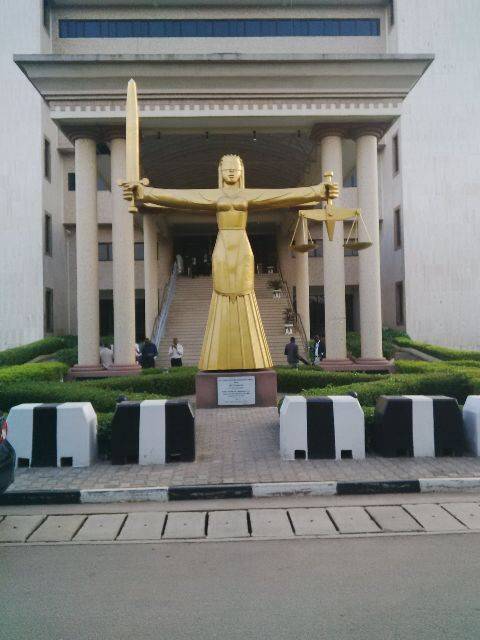
The Federal High Court in Abuja on Tuesday sentenced five terrorism convicts to various jail terms, including 20 years imprisonment.
The court also remanded another suspect who pleaded not guilty to terrorism charges, as the Federal Government began a fresh phase in the mass trial of 500 suspects.
Justice M. O. Olajuwon remanded Babagana Umar in the custody of the Department of State Services, after he denied a three-count charge bordering on alleged support for Boko Haram.
Umar was accused of “knowingly rendering support by supplying spare parts to Boko Haram,” as well as supplying firewood to the terrorist group in Sambisa Forest in 2022, contrary to Section 13 of the Terrorism (Prohibition and Prevention) Act, 2022.
He was also alleged to have had “information about the whereabouts and activities of Boko Haram, which would have led to apprehension and prosecution of these persons… but did not disclose to any law enforcement agency,” contrary to Section 16 of the Act.
The court adjourned Umar’s trial to the next sitting.
In a separate case before the same court, Justice Olajuwon convicted Yusuf Tuggar Abacha to 20 years’ imprisonment after he pleaded guilty to professing membership of Boko Haram, withholding information about a member of the group, and participating in attacks.
The court struck out a count relating to an agreement to receive AK-47 handling training before proceeding to conviction.
“I hereby sentence him to 20 years imprisonment on each count, to run concurrently, and he is to be rehabilitated and de-radicalised after serving his term,” Justice Olajuwon ruled.
Meanwhile, in related proceedings before Justice Binta Nyako, four other defendants were convicted and sentenced in separate cases.
In FHC/KMJ/CR/583/2026, a defendant who pleaded guilty to membership of Boko Haram, provision of material support, and handling of funds linked to the group was sentenced to 10 years on each of four counts, to run concurrently.
“I hereby sentence the convict to a term of 10 years imprisonment for each count charge from the date of his arrest to run concurrently… He is to undergo rehabilitation and de-radicalisation,” Justice Nyako said.
Isa Ali was sentenced to 10 years for providing logistical support to Boko Haram, with a membership count struck out following a not-guilty plea.
Auwal Bello received 10 years for facilitating terrorism financing, including exchanging about N750,000 and paying N20,000 to the group.
Shehu Bukar was sentenced to 20 years for supplying cattle and goats to Boko Haram.
Justice Nyako described his offence as “so gruesome” and rejected defence pleas for leniency.
“I hereby sentence him to a term of 20 years imprisonment from the date of his arrest. He is also to undergo rehabilitation and de-radicalisation,” she said.
All convicts were directed to undergo rehabilitation and de-radicalisation, with the Ministry of Interior determining the correctional facilities where they will serve their terms.
The Federal Government’s fresh mass trial, in its ninth phase, is being handled by 10 judges sitting during the court’s Easter vacation to fast-track proceedings.
Attorney General of the Federation and Minister of Justice, Lateef Fagbemi (SAN), confirmed that although 500 suspects are slated for trial, 227 were taken before the courts on the first day.
“Don’t forget this is an Easter period. Ordinarily, the judges are not supposed to be here… but they have been so patriotic, and they have put their service to the nation.
“For phase nine, we have 500 in all, and it will last to either Friday or Saturday,” Fagbemi said.
The suspects face allegations of participating in attacks, particularly in northern Nigeria, leading to more than 2,000 deaths, as well as financing terrorism, supplying arms, ammunition, food, and other logistics.
Fagbemi said the trials were moved to Abuja for logistical convenience, rather than the usual practice of ferrying the judges to Kainji or Maiduguri to conduct the trials.
“Whether in Kainji or Maiduguri, the people to try terrorism suspects are judges of the Federal High Court.
“For logistic problems, it is not convenient to go to Kainji… the availability of multiple courtrooms here makes it possible for several judges to sit simultaneously,” he said.
He stressed that the proceedings were being conducted openly, with local and international observers, including Amnesty International, United Nations Office on Drugs and Crime, and members of the Nigerian Bar Association present in the courts.
“It is in the open. It’s not a secret trial. You will see where confessions are made, where proof is given. Everything is in the public glare,” he said.
Our correspondent reports that security was heightened around the court premises, with suspects transported in trucks under heavy guard by personnel of the Department of State Services, as well as officers of the Nigeria Police and the Nigerian Army.
Speaking on the defence’s role, Director-General of the Legal Aid Council, Aliu Abubakar, said the defence’s job was “made easy” as many suspects admitted to the charges.
“The thing with terrorism trials is that it is made easy a little… because the majority of the suspects admit to committing the crime. This has been our experience over the years, and today’s trial is not different,” he said.
He added, “A large number of them are also convicted for association with Boko Haram. Some of them are not active participants… but they are being convicted… association is as grievous as committing an offence.”
Abubakar also noted that some suspects were discharged and acquitted.
“Happily, I can say that one or two of them have been discharged and acquitted… for somebody who has been in detention for four, five years… to be acquitted, it shows that the trial has some level of transparency,” he said.
He confirmed that pre-trial interviews were conducted in Maiduguri and Kainji to ensure due process:
“Yes, we did. It is a prerequisite of the law… we had an opportunity to talk to them… before the main trial taking place today,” he said.
The trials are expected to continue on Wednesday, April 8, 2026.