
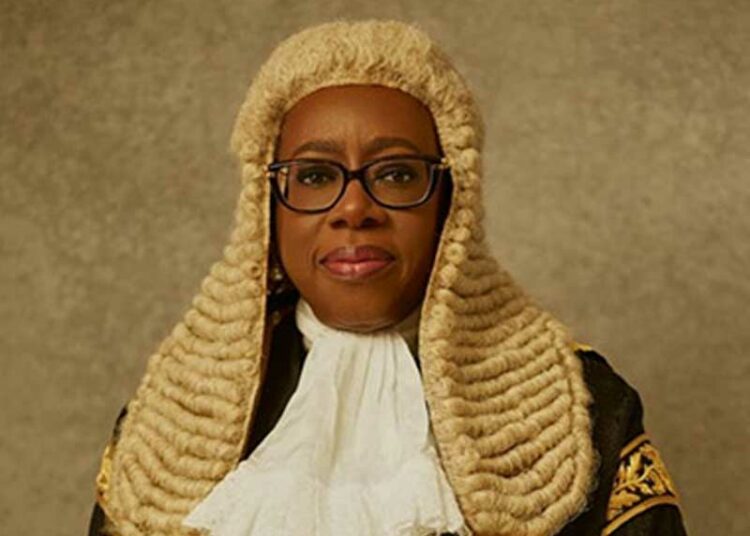
The Chief Justice of Nigeria (CJN), Justice Kudirat Kekere-Ekun, on Wednesday, advised lawyers to uphold ethical standards and prioritise justice over monetary gains.
Also, Prof. Yemi Osinbajo (SAN) said that the credibility of the judiciary depends not only on legal correctness but also on transparency, consistency, and clarity in judicial reasoning, particularly in politically sensitive cases.
They spoke in Lagos at the opening session of the 2026 Annual Conference of the Nigerian Bar Association Section on Legal Practice (NBA-SLP) with the theme, “Evolving Trends: Nigerian Legal Practice, Global Perspectives”.
While declaring the conference open, Justice Kekere-Ekun said, “Law is not, and must never become, a purely commercial venture driven only by financial incentives. While the legal practitioner is unquestionably entitled to fair remuneration for professional services rendered, the acceptance of briefs must ultimately be guided by conscience, professional responsibility, and fidelity to justice.”
The CJN also expressed concern that some lawyers accept briefs primarily for financial gain rather than for justice or the advancement of jurisprudence.
“There is rising worry that, in some instances, briefs are accepted primarily for monetary gain, without sufficient regard for enforcing clients’ rights or advancing our jurisprudence,” she said.
The CJN cautioned that such behaviour could harm the profession’s integrity and that this approach might diminish lawyers’ noble role, transforming it from principled representation into mere transactional advocacy.
Justice Kekere-Ekun reminded lawyers of their dual roles as advocates and custodians of justice, emphasising that their duty extends beyond winning cases.
“Your responsibility is not only to win cases but also to assist the court in achieving justice, discourage frivolous lawsuits, and ensure the law’s machinery is not used for delay, oppression, or abuse of process,” she maintained.
The CJN stressed that ethical conduct, honesty, and dedication to the rule of law are vital for the profession’s credibility.
“The long-term reputation of the legal profession depends on more than success; it relies on ethical integrity, intellectual honesty, and unwavering commitment to the rule of law,” she stated.
On his part, Prof Osinbajo recognised that under Nigeria’s constitution, Supreme Court rulings in electoral cases are final and cannot be appealed; he, however, cautioned that finality doesn’t necessarily mean infallibility in the eyes of the public.
“The Supreme Court is final, not because it is always correct, but because litigation must come to an end,” he stated.
The former VP, Osinbajo also expressed concern that controversial election-related judgments have at times weakened public trust in the judiciary, noting that when decisions seem unfair or misaligned with the electorate’s will, they create a legitimacy gap.
Referencing the 2019 Zamfara governorship dispute involving the APC and Senator Kabiru Marafa, he pointed out that the court’s ruling to nullify votes based on flawed primaries raised fundamental issues about electoral justice.
He explained that despite large votes for APC candidates across the state, the court declared the votes invalid and awarded victory to candidates who had been rejected at the polls.